By Sampath Kumar Iyengar
In recent decades, conversations around women’s empowerment and gender advocacy have largely been framed through modern socio-political lenses. While these efforts have created important spaces for dialogue and reform, it is equally important to ask: Is empowerment a new idea in the Indian civilizational context? Or have we drifted away from frameworks that were already deeply equitable?
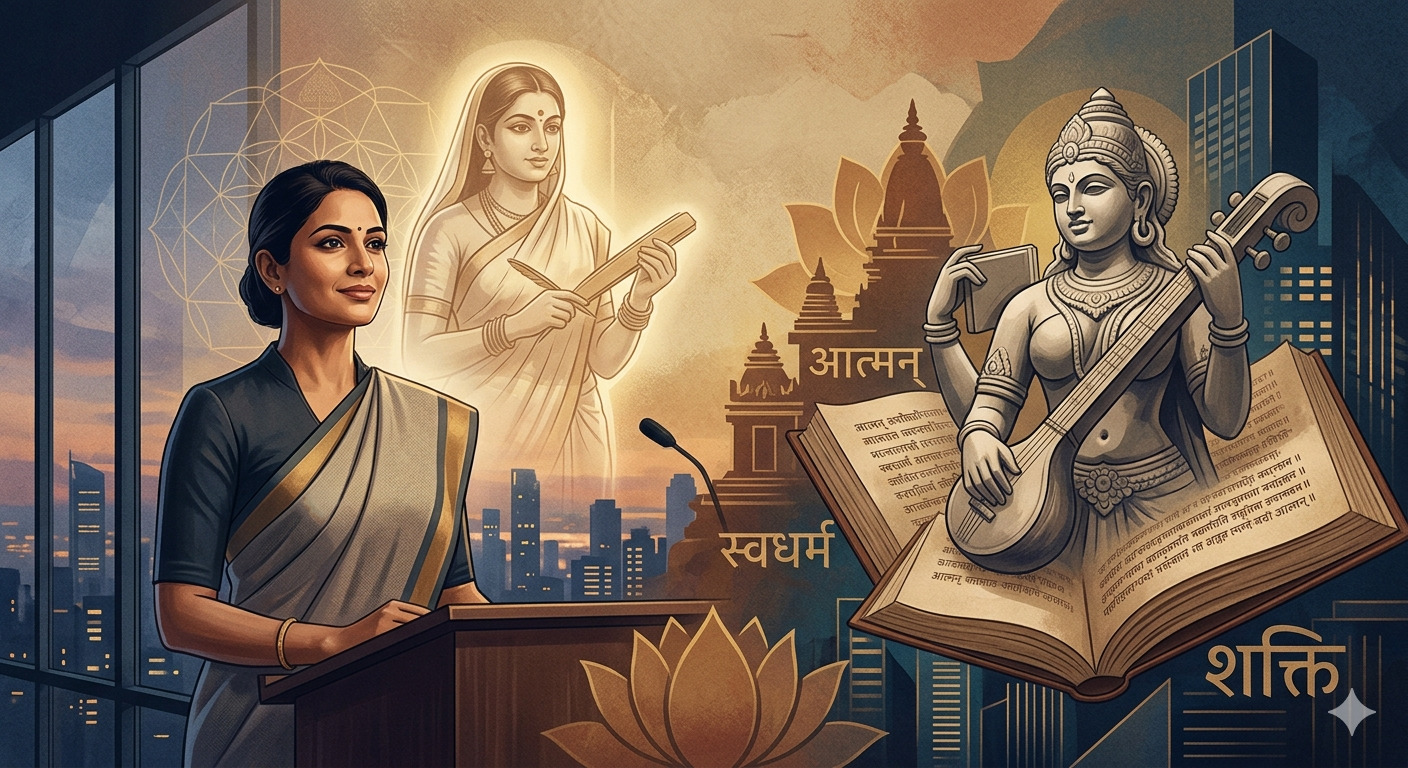
From the standpoint of Vedanta and the wisdom of Hindu scriptures, the idea that women need validation to be seen as powerful is, in many ways, alien. Not because inequities have not existed, they have, as they do in every society, but because the philosophical foundation of Sanatana Dharma does not place human worth on gender. It places it on SvaBhava, one’s intrinsic nature and SvaDharma, one’s rightful expression of that nature in action.
Beyond Gender: The Centrality of SvaBhava
Vedanta separates identity from external labels. The core teaching is that the true self, the Atman, is beyond body, beyond gender, beyond social constructs. What distinguishes individuals is not male or female identity, but temperament, aptitude, disposition and inner calling.
In professional and social contexts, human beings inhabit roles. Some roles we are born into, daughter, son, sibling, are shaped by filial and familial circumstances. Other roles arise from choices we make, professions we pursue, responsibilities we accept, paths we carve within the constraints and opportunities of our time.
Vedantic thought does not conflate these roles with inherent worth. Instead, it asks a deeper question: What is your SvaBhava? What is the nature of your inner design? When action aligns with SvaBhava, excellence and fulfillment naturally follow, irrespective of gender.
This framework is strikingly relevant for modern corporate leadership. Organisations often struggle with diversity conversations because they focus on demographic balancing without adequately engaging with individual essence. True inclusion, from a dharmic lens, is about enabling every individual, woman or man, to operate in alignment with their SvaBhava.
Historical Memory: Women in Leadership and Scholarship
Ancient Indian history offers abundant examples of women occupying positions of intellectual, political and spiritual authority. Women such as Gargi and Maitreyi were not peripheral participants in philosophical discourse; they were central interlocutors in debates on metaphysics and self-realization. Queens governed kingdoms. Women led communities, composed hymns and shaped jurisprudence.
These were not anomalies justified by exception. They were expressions of a culture that recognized capacity as primary. The reverence of the feminine principle as Shakti, the dynamic energy that animates existence is not poetic symbolism alone. It is a philosophical assertion that power, intelligence and creative force are not gendered attributes.
Over time, socio-economic shifts and historical disruptions created distortions. But distortions are not doctrines. To address contemporary bias, we must distinguish between civilizational philosophy and later social practice.
The Limits of Reactionary Frameworks
Modern gender discourse often emerges from understandable frustration. However, solutions anchored in resentment or framed as adversarial struggle tend to create new polarities. Reactionary approaches may generate temporary compliance, but they rarely produce sustainable cultural transformation.
When advocacy becomes oppositional, it risks replacing one imbalance with another. Toxic behaviors do not disappear; they merely change form.
The dharmic approach is fundamentally different. It does not seek revolution through antagonism. It seeks restoration through alignment. If individuals are encouraged to discover and act in accordance with their SvaDharma, social harmony follows organically.
SvaDharma is gender agnostic. It is the rightful duty that arises from one’s nature and context. A woman’s SvaDharma may express as corporate leadership, entrepreneurship, scholarship, caregiving, governance or a blend of these. The same applies to a man. The criterion is not conformity to expectation, but integrity to one’s inner design.
Merit as a Guiding Principle
Broadly speaking, merit must be the guiding principle of any equitable society. But merit, properly understood, is not a narrow metric of output. It is the flowering of SvaBhava through disciplined action.
When systems privilege gender over competence, in either direction, they undermine both excellence and dignity. Conversely, when systems recognise individual capability, commitment and alignment, they honour both fairness and performance.
In corporate leadership, this translates into structures that assess contribution without unconscious bias, while simultaneously ensuring that cultural conditioning does not suppress authentic talent. The goal is not to engineer sameness, but to enable authenticity.
Reclaiming a Timeless Framework
On International Women’s Day, perhaps the most powerful step forward is not to import frameworks uncritically, but to re-engage with the philosophical resources already embedded in our tradition.
To call women Shakti is not ceremonial. It is a reminder that creative force, resilience and transformative capacity are intrinsic. Empowerment, in this view, is not granted; it is recognised.
This recognition does not negate the need to address real inequities. It simply anchors the solution in principles that are universal and timeless rather than transient and reactionary.
If we educate both boys and girls in the understanding that identity is deeper than gender, that duty arises from inner nature, and that dignity is inherent, we cultivate a culture where advocacy becomes less about confrontation and more about coherence.
A Leadership Imperative
For leaders, whether in corporations, academia or public life, this perspective carries practical implications. Policies must ensure fairness. Opportunities must be accessible. But beyond compliance, leadership must foster environments where individuals are encouraged to discern their SvaBhava and pursue their SvaDharma with courage.
When a woman leads from alignment rather than from defensive assertion, her authority carries quiet power. When a man supports equity not from guilt, but from philosophical clarity, his allyship is stable.
Timeless principles outlast ideological cycles. Civilizations endure not by discarding their roots, but by reinterpreting them intelligently for contemporary life.
The wisdom of our scriptures does not deny gender; it contextualizes it. It reminds us that beyond the roles we inhabit lies a shared human essence. And when action flows from that understanding, equality ceases to be a slogan. It becomes a lived reality.
In that sense, the feminine has never been weak, peripheral or secondary. It has always been Shakti- equal, essential and enduring.
__________________________________
Sampath Kumar Iyengar is Chairman, MetaValue Advisors and Founder, Intellect Yoga Institute. He was previously Partner of a Wall Street hedge fund and CEO of a global IT company. Views expressed are personal