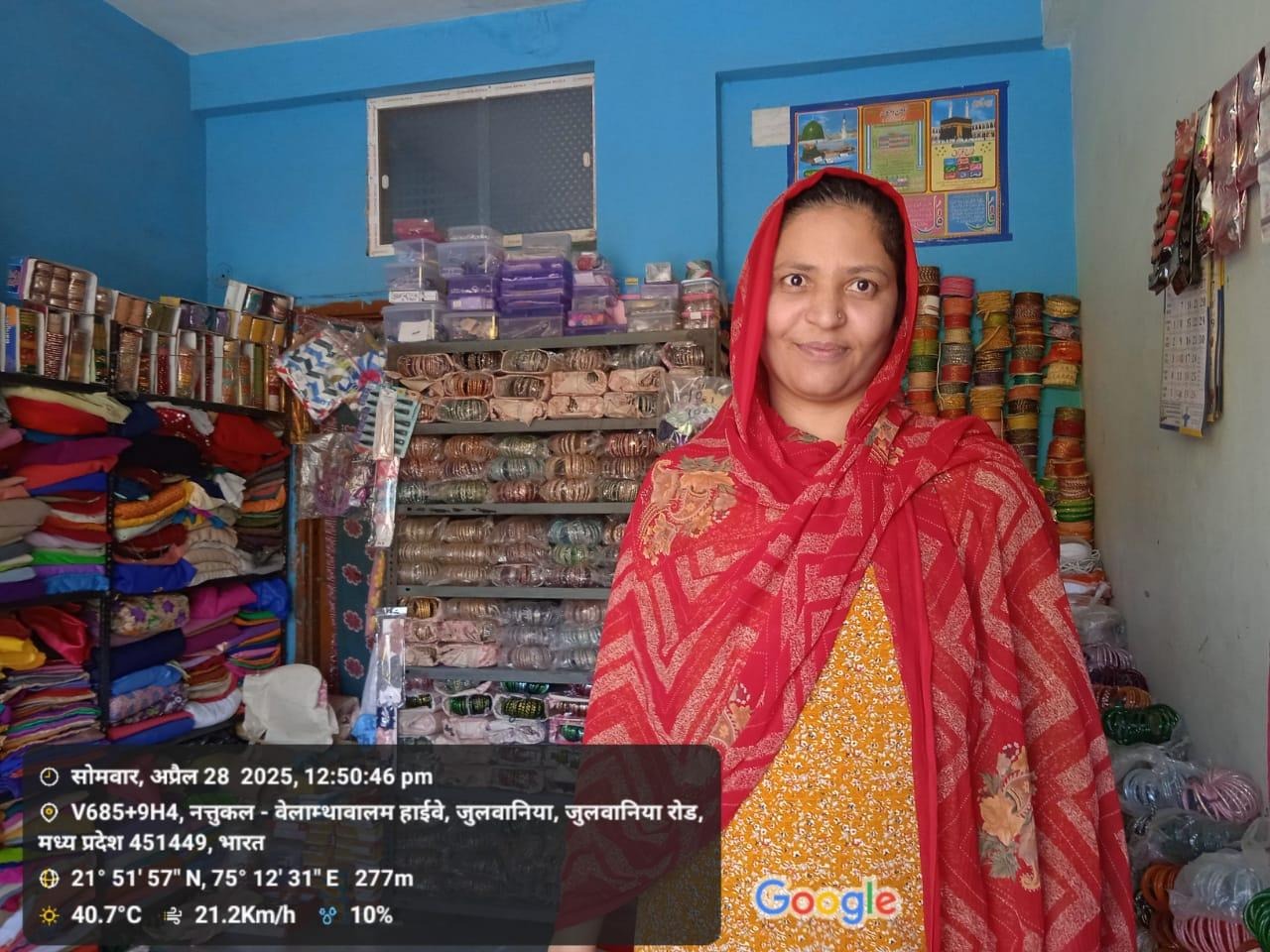
This case study narrates the inspiring journey of Rukhsana Bi, a 33-year-old entrepreneur from Julwaniya, Barwani, who transformed her aspiration for self-reliance into a thriving textile business, “Ayesha Collection Cloth Shop.” Her story highlights resilience, community support, and the empowering impact of economic independence.
Rukhsana Bi, a woman from the backward class, spent her childhood in a financially constrained but happy family, lacking many amenities. She completed her education up to the 8th grade but was unable to pursue further studies due to the prevailing societal norms and lack of encouragement for girls’ education within her Muslim family, where emphasis was placed on learning household chores. Before establishing her shop in November 2023, Rukhsana was primarily occupied with household duties, constantly aspiring to become self-sufficient and contribute to her family financially.
Her husband and mother-in-law have been steadfast in their support. When Rukhsana expressed her desire to open a shop, they readily assisted her and expressed their joy. Prior to her venture, Rukhsana had no personal income; her husband’s income ranged from ₹7,000 to ₹8,000. Her inspiration to become an entrepreneur was significantly fueled by the Enterprise Facilitation Hub (EFH) Julwaniya, whose consistent engagement in self-help group meetings about employment and learning instilled confidence and a sense of possibility within Rukhsana.
Rukhsana’s decision to venture into the cloth business stemmed from a clear understanding of a local market gap. Being a small village, Julwaniya lacked shops selling fabric by the meter, forcing residents to travel to Sendhwa or Khargone for purchases. Inspired by a female relative who was already in the cloth business, Rukhsana felt confident she could succeed in selling clothes.
Her initial step was to approach the EFH coordinator, expressing her interest in the cloth trade. The coordinator helped her develop a business plan and secure a loan from the Gram Sangathan. As her shop gained traction, she acquired an additional loan from HDFC to expand her inventory. Alongside clothes, she also began selling bangles, for which Taniya Didi provided market information about Khalghat and Indore. Rukhsana gradually expanded her stock, and her shop now holds goods worth approximately ₹300,000.
Her business, “Ayesha Collection Cloth Shop,” primarily deals in clothes and bangles. During peak seasons, she also sells readymade kurtas and suits. This diversification contributes to a seasonal income of ₹40,000-₹50,000, with daily earnings of ₹400-₹600, accumulating to a monthly income of roughly ₹12,000-₹15,000. Rukhsana has established her shop in a rented space near the Gayatri Temple in the market. She serves approximately 200 families in Julwaniya and women and girls from surrounding villages.
Before starting her shop, Rukhsana carefully considered her ability to sell the goods and manage household responsibilities. She addressed her husband’s initial concerns about loan interest by explaining the lower rates and the assistance offered by Julwaniya EFH. A crucial part of her preparation involved creating a business plan, determining sourcing and quantity of goods, and initially selling from home before renting a shop. She found market surveys and understanding different suppliers’ rates to be most important. Throughout her journey, Rukhsana received constant guidance from her family (husband, mother-in-law, sister) and EFH. The coordinator provided market insights, helped prepare her business file, and offered timely suggestions.
Her path wasn’t without difficulties. Initially, she depended on her husband’s availability to travel for sourcing goods, fearing missed seasonal opportunities. The fear of carrying large sums of money for purchases alone and being overcharged by traders were also concerns. She also struggled with expanding her shop and finding new designs. These fears gradually subsided as she gained market knowledge. She experienced stress from unsold stock and the occasional depletion of business capital for household expenses, sometimes leading to tears of frustration, but she has learned significantly from these challenges. Her shop’s monthly expenses, including rent, water, and electricity, amount to ₹3,000. An additional ₹1,000 is incurred for sourcing goods. As mentioned, her monthly income averages ₹12,000 to ₹15,000. She has expanded her business by adding bangles and other cosmetic items. Rukhsana intends to further expand her business.
Rukhsana feels a significant improvement in her life, having gained self-confidence and recognition in society by her own name, and she actively contributes to her family’s finances. Previously, she was only consulted for household tasks, but now her mother-in-law and husband involve her in family decisions. She has established her own identity in society, where people now value her, and she has built friendships with whom she shares her experiences. She proudly shares that her shop has given her courage and a social identity. No longer dependent on her husband for money, she can now spend on herself and even provide financial assistance to her maternal family. She expresses joy in transforming from someone who was “nothing” to someone capable of helping her family. Rukhsana considers her children, who now attend private school, her greatest achievement, as she has come to understand the importance of education and earning. Her ability to earn is her personal triumph.
In the next ten years, Rukhsana envisions her business growing substantially. She aims to transition from a rented space to owning her own shop.